
As a small business owner, your marketing efforts can feel like a guessing game. You post on social media, you update your website, you run an ad here or there … but it’s hard to know if what you’re doing is truly moving the needle. It’s easy to feel overwhelmed, to wonder if you’re spending your limited time and money in the right places.
The truth is, even the largest corporations don’t just throw things at the wall to see what sticks. They start with a simple, powerful framework that can be even more effective for a small, agile business like yours: the SWOT analysis.
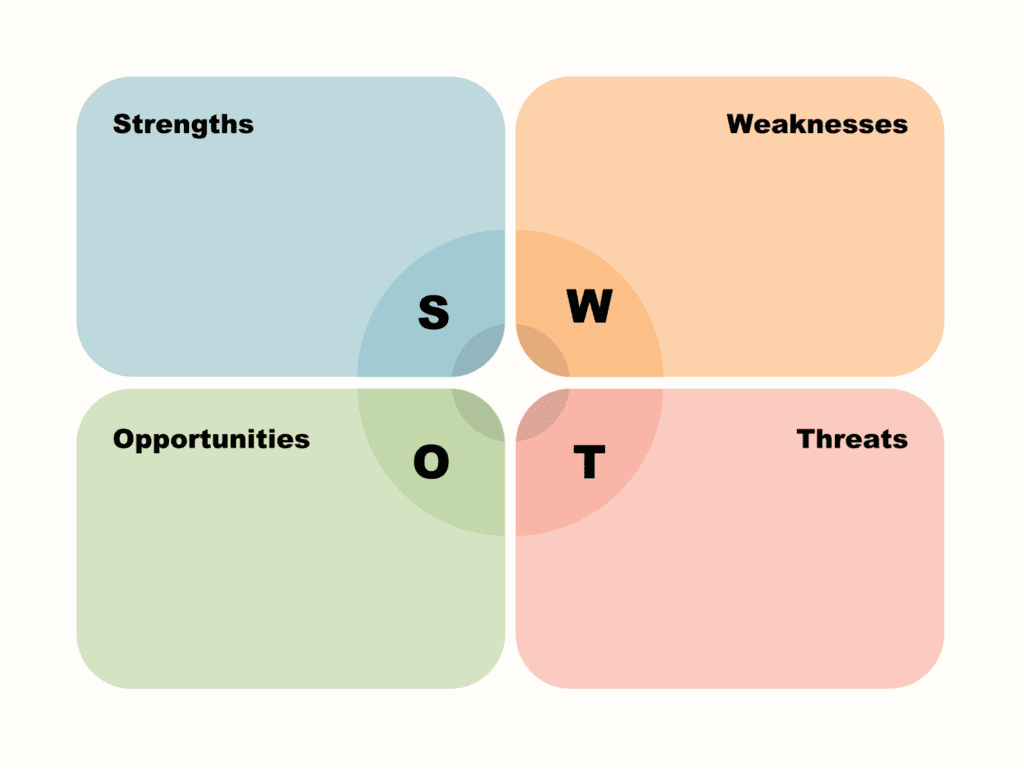
A SWOT analysis is a strategic planning tool used to evaluate your business’s Strengths, Weaknesses, Opportunities and Threats. While it’s often used for overall business strategy, its true power for a small business lies in a laser-focused look at your marketing efforts. It gives you the clarity you need to stop guessing and start building a focused, effective marketing plan that truly grows your business.
The Why: A SWOT Analysis is Your Marketing Compass
Before we dive into the steps, it’s critical to understand the profound impact a simple SWOT analysis can have on your marketing strategy. This isn’t just a corporate exercise; it’s a tool for survival and growth.
- You Save Time and Money: A SWOT analysis forces you to identify what’s working and what’s not. By recognizing your weaknesses (e.g., an outdated website) and threats (e.g., a new competitor), you can avoid wasting money on ineffective tactics and instead focus your budget on strategies that directly address your challenges and leverage your strengths.
- You Find Your Unique Selling Proposition (USP): By analyzing your strengths, you’ll discover what makes you truly special. Is it your unparalleled customer service? Your unique product quality? This discovery is the key to crafting a marketing message that stands out and tells customers why they should choose you over anyone else.
- You Reveal Hidden Opportunities: The “Opportunities” quadrant forces you to look outside your business and spot market trends, new technologies, or local events you could capitalize on. A simple SWOT could reveal that a new social media platform is gaining traction with your target audience, or that a major local festival presents a perfect marketing opportunity.
- You Prepare for the Unexpected: No matter the market, anticipating threats is vital. By identifying potential challenges like a negative review, a new competitor or a downturn in the economy, you can build a proactive plan to mitigate them.
The “How”: A Step-by-Step Guide to a Marketing SWOT
Grab a piece of paper or open a document and divide it into four quadrants. Now, let’s fill them out, focusing specifically on your marketing.
1. Strengths (Internal, Positive)
What does your business do well? What are the internal factors that give you an advantage over your competition?
- Example for a local bakery:
- Your Products: Your recipes are family secrets, and your bread is the best in town.
- Your Team: Your staff is incredibly friendly and knows customers by name.
- Your Customers: You have a small but incredibly loyal customer base that loves you.
Marketing application: Your strength isn’t just your bread; it’s the loyal customers who buy it. These are your best brand advocates. A marketing strategy could focus on getting more five-star reviews from them or launching a referral program. Your friendly team is a marketing asset that can be featured on social media, showcasing the welcoming experience.
2. Weaknesses (Internal, Negative)
What are your internal shortcomings? What factors within your control are holding back your marketing efforts? Be honest with yourself.
- Example for a local bakery:
- Your Website: It’s old, not mobile-friendly, and has no clear way to order online.
- Your Social Media: You post inconsistently, and your images are low-quality.
- Your Data: You don’t have a way to track where your customers are coming from.
Marketing application: These weaknesses are holding you back. A potential customer looking for a local bakery on their phone will struggle to use your website. Your inconsistent social media makes your business look less active than it is. These are your top priorities for marketing investment.
3. Opportunities (External, Positive)
What is happening in your industry or local community that you can leverage? These are factors outside your control that you can take advantage of.
- Example for a local bakery:
- Market Trend: The growing interest in gluten-free and health-conscious baked goods.
- Local Event: A new farmer’s market is starting up this spring.
- Competitive Shift: A local competitor just closed its doors, leaving a gap in the market.
Marketing application: The opportunity isn’t the trend itself, but how you market it. You could launch a blog series on “Healthy Baking with Local Ingredients” to capitalize on the market trend. You could build a booth at the new farmer’s market and promote your participation on social media.
4. Threats (External, Negative)
What are the external factors that could pose a risk to your business? These are challenges you must prepare for.
- Example for a local bakery:
- Competitor: A new national chain is opening a location with a huge marketing budget.
- Economic Downturn: People might spend less money on non-essentials.
- Negative Reviews: A handful of bad online reviews could harm your reputation.
Marketing application: You can’t stop the national chain from opening, but you can prepare. Your marketing can focus on your unique, local identity and the relationships you’ve built, which the chain can’t replicate. You can build a strategy to actively generate positive reviews to counter the threat of a single negative one.
From Analysis to Action: Building Your Marketing Plan
The SWOT is just the beginning. The real power is in using the insights to build a clear, actionable marketing plan. This is where you connect the quadrants to build a strategic roadmap.
- Strengths + Opportunities (S-O Strategy): How can you use your loyal customer base to capitalize on a new farmer’s market? Action: Run an exclusive referral program for your most loyal customers, giving them a special deal in exchange for telling their friends about your new booth at the market.
- Strengths + Threats (S-T Strategy): How can you use your superior product quality to fight against the new national chain? Action: Launch a social media campaign that highlights your family-secret recipes and the quality of your ingredients, contrasting your authenticity with the chain’s mass-produced goods.
- Weaknesses + Opportunities (W-O Strategy): How can you leverage the opportunity of a new health food trend to overcome your outdated website? Action: Invest in a new, mobile-friendly website with a dedicated blog, and start a blog series about your healthy baking options.
- Weaknesses + Threats (W-T Strategy): How can you use a new reputation management system to protect against the threat of negative reviews? Action: Implement a system to automatically follow up with customers, encouraging positive reviews and addressing concerns privately before they become a public issue.
The Final Step: Turning Insight into a Reality
A SWOT analysis is a powerful tool for clarity. It moves you from a feeling of being overwhelmed to a sense of purpose and direction. You know your strengths, you’re aware of your weaknesses, and you have a plan to seize opportunities and counter threats.
However, moving from a completed SWOT analysis to a fully-executed marketing plan can still be a significant challenge for a small business owner. It requires the time, expertise and resources to build the website, manage the social media and run the campaigns that your SWOT analysis identified.
At Rooted Web, we specialize in helping businesses in our community turn their strategic insights into real results. We can help you conduct your SWOT analysis and then build the full-scale marketing plan to bring that vision to life, so you can focus on what you do best.
Ready to stop guessing and start building a powerful, focused marketing strategy? Let’s discuss a plan that turns your SWOT analysis into sustainable growth. Contact Rooted Web today.